
The Drawing Becomes a World
Harold and the Purple CrayonHarold's marks progress from useful props to a responsive environment whose dangers and possibilities he must navigate.
increasing Bearing strength in each event
 decreasing
Bearing strength in each eventdecreasingCreating the Essentials
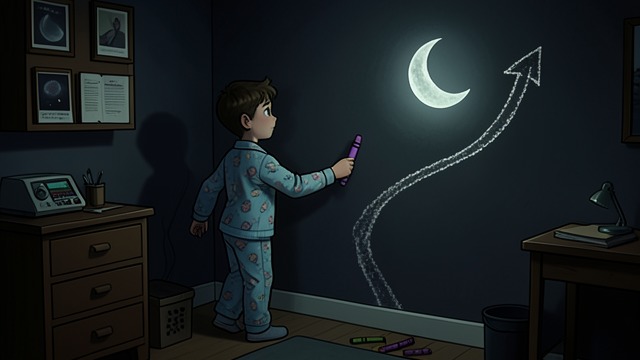
Making the Walk Possible
A world with gaps
Harold's plan cannot proceed in an empty scene: there is no Moon and no path. Rather than abandon the walk, he uses the purple crayon to supply what the imagined outing lacks.
Creation as action
The drawings are not decorations. Each one changes what Harold can do next, establishing the central pattern in which imagination makes the setting and the setting immediately tests the imagination.
The World Pushes Back
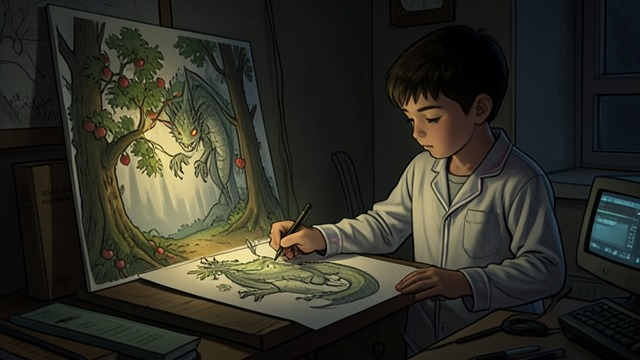
Consequences of Creation
A threat takes shape
Harold draws a forest, an apple tree, and a frightening Dragon to guard the fruit. The world becomes more elaborate, but elaboration also brings danger: the guardian frightens Harold himself.
A sudden loss of control
His shaking hand leads into an ocean, placing him over his head in water. The shift shows that drawing can create consequences faster than Harold can calmly anticipate them.
A World Made Livable
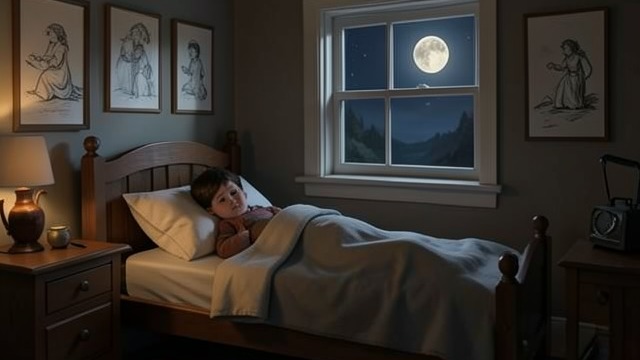
From Invention to Shelter
Finding orientation
After the city fails to reveal his bedroom, Harold recalls the relation between his window and the Moon. His accumulated inventions have not given him the answer; a remembered pattern in the created world does.
Making rest
Harold draws a bed and gets under the covers. Creation ends not with another adventure but with a small, fitting shelter, turning the crayon's power toward rest rather than expansion.
At the beginning, before Harold sets off
In the middle, after the dragon frightens Harold
Near the conclusion, when Harold remembers the Moon's position
